
Making Healthier Choices: Your Essential Guide to Buying Organic Produce
Ever since welcoming our child, Reece, five years ago, our family’s awareness and attention to the foods consumed in our home have dramatically increased. A foundational shift has been prioritizing a diet rich in fruits and vegetables, recognizing their indispensable role in overall health and well-being. Whenever feasible, we consciously choose organic options, driven by a desire to minimize our exposure to synthetic pesticides and chemicals.
Navigating the complex world of food choices, especially when aiming for a healthier lifestyle, can often feel overwhelming. Conflicting information, diverse labeling, and varying price points can make grocery shopping a daunting task. However, one invaluable resource has consistently illuminated our path and simplified our decision-making process: the Environmental Working Group’s (EWG) Shopper’s Guide to Pesticides in Produce. This guide has not only transformed our approach to grocery shopping but has also empowered us to make informed, impactful choices that align with our family’s health goals and budget.
Unpacking the EWG Shopper’s Guide: Understanding the Dirty Dozen and Clean Fifteen
Each year, the Environmental Working Group (EWG) — a non-profit, non-partisan organization dedicated to protecting human health and the environment — releases its highly anticipated Shopper’s Guide to Pesticides in Produce. This comprehensive guide stands as a crucial tool for consumers striving to make sense of modern agricultural practices and food safety standards.
The guide meticulously analyzes and ranks popular fruits and vegetables based on the quantity of pesticide residues detected on them. Its data is derived from tens of thousands of produce samples tested by the U.S. Department of Agriculture and the Food and Drug Administration. This rigorous scientific methodology provides consumers with a clear, evidence-based understanding of which produce items carry the highest and lowest pesticide loads.
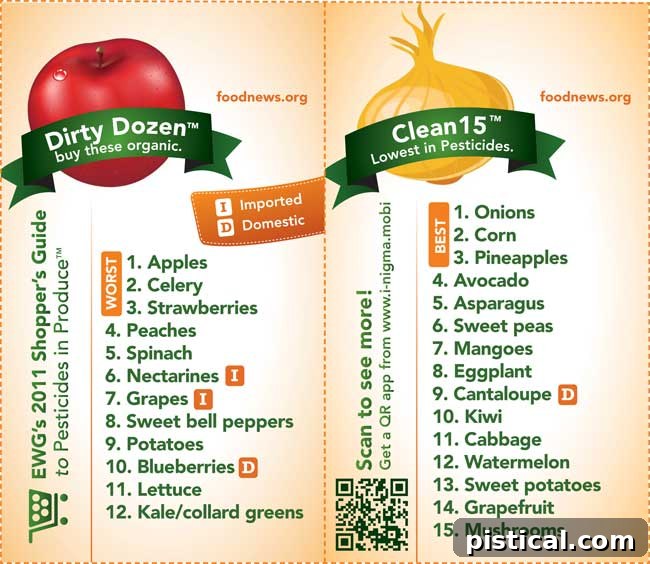
The EWG categorizes produce into two essential lists: the Dirty Dozen, which identifies the 12 produce items with the most significant levels of pesticide contamination, and the Clean Fifteen, which highlights the 15 produce items found to have the lowest pesticide residues. These rankings are practical and relevant, as they consider how each item is typically consumed — including standard washing and peeling processes. My discovery of this incredibly informative guide a little over a year ago marked a significant turning point, allowing me to refine my organic shopping habits and prioritize my purchases with newfound confidence.
While the EWG strongly recommends choosing organic options whenever feasible, it also acknowledges the financial constraints many households face. It’s a prevalent misconception that one must exclusively purchase organic produce to maintain a healthy diet. In reality, for most families — including mine — an entirely organic grocery cart is simply not affordable. And here’s the reassuring truth: you don’t have to buy everything organic!
The overarching message, which bears repeating, is this: The immense health benefits of consuming fruits and vegetables — regardless of whether they are organic or conventionally grown — far outweigh the potential risks associated with pesticide exposure. If your budget doesn’t stretch to include organic versions of every item, please continue to fill your plate with a colorful array of produce. The essential vitamins, minerals, fiber, and antioxidants found in fruits and vegetables are vital for good health, irrespective of their cultivation method. The EWG guide is designed not to deter you from conventional produce, but rather to serve as a strategic roadmap, helping you intelligently allocate your “organic dollars” where they can have the most meaningful impact.
Smart Shopping: Maximizing Your Organic Budget Without Compromise
Bridging the price gap between organic and conventional produce is a common hurdle for many health-conscious shoppers. To effectively stretch your organic budget, I highly recommend adopting a proactive approach: create a simple price comparison sheet. Track the costs of both organic and non-organic versions of the fruits and vegetables you frequently buy at your favorite grocery stores and local farmer’s markets. This systematic practice will empower you to pinpoint:
- Which retail outlets consistently offer more competitive prices on organic produce.
- Specific fruits and vegetables where the price difference between organic and conventional is minimal, making the organic choice more accessible.
From my personal experience, I aim to purchase organic produce when its price is less than 25% higher than its conventional counterpart. You might be pleasantly surprised by what you discover! For example, I have a particular grocery store where organic produce is often priced comparably to conventional items. Occasionally, during sales, organic selections can even be cheaper than their non-organic equivalents! I’ve consistently found organic apples, various lettuces, and leafy greens to be very reasonably priced, making them easy staples in our organic basket.
Beyond meticulous price comparison, consider these additional, actionable tips to integrate more organic options into your diet wisely:
- Embrace Seasonal Eating: Produce that is in season is typically more abundant, fresher, and often significantly less expensive, whether organic or conventional. Local seasonal produce also supports local economies and reduces your carbon footprint.
- Explore Local Farmer’s Markets: Many small-scale local farmers employ organic or sustainable growing practices, even if they haven’t gone through the rigorous and costly process of official organic certification. Their prices can often be very competitive, and you can directly inquire about their farming methods.
- Utilize Frozen Organic Options: Frozen organic fruits and vegetables are picked at their peak ripeness and flash-frozen, locking in nutrients. They are often more affordable than their fresh organic counterparts and can significantly reduce food waste, making them a smart, budget-friendly choice.
- Prioritize the Dirty Dozen: If financial constraints limit your organic purchases, focus your efforts on items from the Dirty Dozen list. This is where your investment in organic produce will yield the greatest benefits by substantially reducing your family’s exposure to pesticide residues.
By integrating these astute shopping strategies, you can confidently incorporate organic produce into your diet without straining your finances, thereby ensuring your family benefits from cleaner eating within a sustainable and manageable budget.
The EWG’s Indispensable Lists: Dirty Dozen and Clean Fifteen for Informed Choices
Having a clear understanding of which fruits and vegetables tend to carry the most — and the least — pesticide residues is fundamental to making truly empowered and health-conscious decisions at the grocery store. These lists serve as an invaluable compass for navigating the produce aisle:
The Dirty Dozen: Prioritize Organic for These Items
These fruits and vegetables are consistently found to have the highest concentrations of pesticide residues. Their susceptibility to absorbing or retaining chemicals makes them prime candidates for organic purchasing to minimize exposure:
- Apples: Often subjected to multiple pesticide applications throughout their growing cycle, their thin skin readily absorbs residues.
- Celery: Lacks a protective outer skin and its stalks can trap numerous pesticides, leading to higher residue levels.
- Strawberries: These delicate, porous berries are frequently treated with a wide array of fungicides and insecticides, and their thin skin offers little protection.
- Peaches: With their soft, fuzzy skin, peaches are particularly vulnerable to pesticide penetration and consistently rank high for residue.
- Spinach: A leafy green with broad, exposed leaves that can easily collect and retain pesticide residues from direct sprays.
- Nectarines: Similar to peaches, nectarines’ smooth skin provides minimal barrier against chemical absorption, making them a concern.
- Grapes (Imported): Imported grapes frequently test positive for a cocktail of multiple pesticide residues, emphasizing the benefit of choosing organic or domestic when possible.
- Sweet Bell Peppers: Their relatively thin skin makes them prone to pesticide absorption, and they often contain residues from various chemicals.
- Potatoes: Pesticides are often applied directly to the soil where potatoes grow, and the crop itself can absorb these chemicals throughout its development.
- Blueberries (Domestic): While a healthy choice, domestically grown blueberries can carry significant pesticide loads, making organic a better option.
- Lettuce: Similar to spinach, lettuce leaves are directly exposed during cultivation and can retain substantial pesticide residues.
- Kale/Collard Greens: Despite their immense health benefits, these popular leafy greens often appear on the Dirty Dozen list due to their broad surface area and common growing practices.
The Clean Fifteen: Safer Conventional Choices for Your Family
These fruits and vegetables consistently show the lowest levels of pesticide residues, making them relatively safer options to purchase in their conventional forms if organic varieties are not readily available or affordable:
- Onions: Grown underground and naturally protected by multiple layers of thick skin, onions are well-equipped to fend off many common pests without heavy chemical intervention.
- Sweet Corn: The sturdy husks of sweet corn act as an excellent natural barrier, effectively preventing pesticides from reaching the edible kernels.
- Pineapples: Their robust, thick, and inedible outer skin provides a formidable shield, protecting the sweet fruit inside from external contaminants.
- Avocado: The famously thick, rough skin of avocados offers superior protection against pesticide penetration, making it a consistently clean choice.
- Asparagus: This vegetable possesses natural defenses that inherently limit its susceptibility to pesticide residues.
- Sweet Peas: Shelled sweet peas are well-protected from external sprays by their pods, ensuring cleaner consumption.
- Mangoes: Similar to pineapples, mangoes feature a thick skin that is typically peeled before eating, significantly minimizing potential exposure.
- Eggplant: Although its skin is consumed, eggplant tends to absorb and retain lower levels of pesticide residues compared to many other vegetables.
- Cantaloupe (Domestic): The thick, sturdy rind of cantaloupe provides a good barrier against external pesticide applications.
- Kiwi: Despite its seemingly delicate skin, kiwi consistently ranks among the produce items with very low pesticide residues.
- Cabbage: The outer leaves of cabbage are often removed, and its compact, tightly packed head offers natural protection to the inner leaves.
- Watermelon: The large, thick rind of watermelon makes it highly resistant to pesticide penetration, keeping the inner flesh clean.
- Sweet Potatoes: As root vegetables grown underground, sweet potatoes are somewhat shielded from surface sprays and generally have low residue levels.
- Grapefruit: Its thick, bitter peel is always removed before consumption, effectively reducing any potential pesticide exposure.
- Mushrooms: Being fungi rather than plants, mushrooms are cultivated in different environments and typically exhibit very low, if any, pesticide levels.
Empowering Your Healthy Lifestyle: Take Action Today
I genuinely hope that this comprehensive guide provides you with valuable insights and practical strategies for making more informed, health-conscious choices about the produce you bring into your home. The ultimate goal is not to cultivate fear or restrict your options, but rather to empower you with knowledge, enabling you to optimize both your family’s health and your household budget simultaneously.
Remember, the EWG has made it incredibly convenient to keep this vital information at your fingertips. I strongly encourage you to print out their easy-to-use reference guide, which you can easily carry with you on your next grocery shopping trip. Furthermore, you can also download their dedicated app for your Android or iPhone device, ensuring that these crucial Dirty Dozen and Clean Fifteen lists are always just a tap away, providing guidance when you need it most.
Are you currently incorporating organic produce into your family’s diet? What are your personal thoughts and experiences with organic foods, and how do you navigate the myriad choices available at the supermarket? Please feel free to share your valuable insights, tips, and challenges in the comments section below – your experiences can be a profound source of inspiration and help for others on their journey towards healthier and more sustainable eating!
here
,
Home Stories A2Z
, and
My Repurposed Life
.